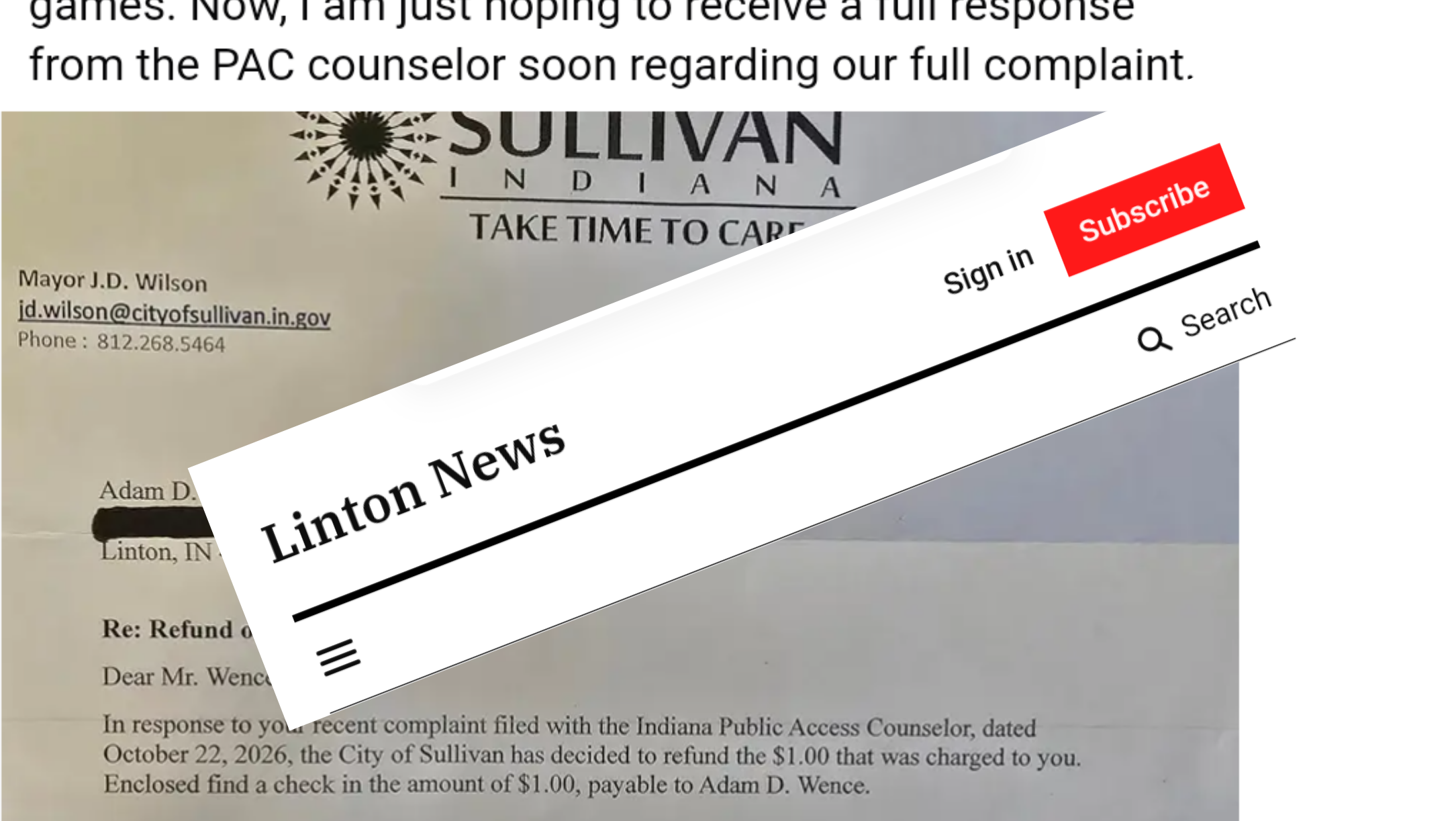

Sullivan, Ind. — On November 13 the City of Sullivan cut a $1.00 check to Adam D. Wence of Linton News and sent it certified mail. The postage label on the envelope showed $11.02. The letter, signed by mayoral assistant Donna Nickless, said the refund answered a complaint Wence filed with the Indiana Public Access Counselor on October 22.
Wence posted the letter, the check, and the postage label on Facebook. He wrote that he would not cash the check. He would frame it. He called it a permanent reminder of government transparency, gross incompetence, and tax dollars spent playing games. He noted that his reporter Shawn Kennedy had been charged roughly eleven dollars on the same request and expected a similar refund.
That is the latest exchange in a running public-records fight between Linton News and the City of Sullivan. The underlying request, filed in September, asked for emails and texts between Mayor J.D. Wilson and Indiana Michigan Power. The company had invited local officials to a Colts suite. Wilson initially accepted, later canceled, and the city released the records after nearly two months. Indiana Public Media reported the episode on October 23. The released correspondence also touched a proposed gas plant and nuclear discussion for Sullivan County.
Indiana’s Access to Public Records Act bars an agency from charging for an electronic copy of a public record sent by email, with narrow exceptions that do not apply here. A one-dollar fee for digital records is hard to square with that rule. Sending a one-dollar refund by certified mail that costs eleven dollars is harder still. Small cities run on small staffs. Certified mail is a blunt instrument for a one-dollar dispute. The arithmetic does not improve because the city eventually wrote the check.
None of that turns the Facebook post into a public-service report. The product on offer is the next volley. The check is framed. The postage is bolded. The reader is told the city is playing games and that a full PAC opinion is still coming. That is a series, not a conclusion. Each installment needs the previous one to make sense, and each installment needs a reaction to stay alive.
This is not unique to Linton or Sullivan. Across the state, small news operations and social-media accounts have learned that a local government will rarely win a purity contest on process. An unreturned call, a paper form, a token fee, a slow response — any of them can be stretched across posts, videos, and comment threads. The attention economy does not pay for the records. It pays for the friction. The longer the friction lasts, the more posts it generates. A city that answers cleanly ends the series. A city that answers clumsily funds the next one.
Sullivan’s handling of the digital fee was clumsy. The certified-mail refund made the clumsiness visible and expensive. That is fair to report. Framing the check and announcing the frame is something else. It keeps the conflict in circulation after the records have already been released and the one-dollar charge has already been reversed. The taxpayers of Sullivan paid $11.02 so a one-dollar check could travel to Linton. They will pay again, in attention and staff time, every time the check is photographed for the next post.
Local government in a county the size of Sullivan does not have a communications office that can match a daily poster. It has a clerk, a mayor, and a part-time attorney. When those people treat a records request as an argument to be won instead of a statute to be followed, they hand the next installment to anyone willing to print the postage label. When the requester treats every response as raw material for another installment, the public gets a serial and not a set of documents.
The PAC opinion, if it arrives, will say whether the fee violated the statute. The $11.02 label already says the city spent more to correct a one-dollar charge than the charge itself. Both facts can stand without the framed check. The series does not need the frame. The frame needs the series.
No thoughts yet — be the first.